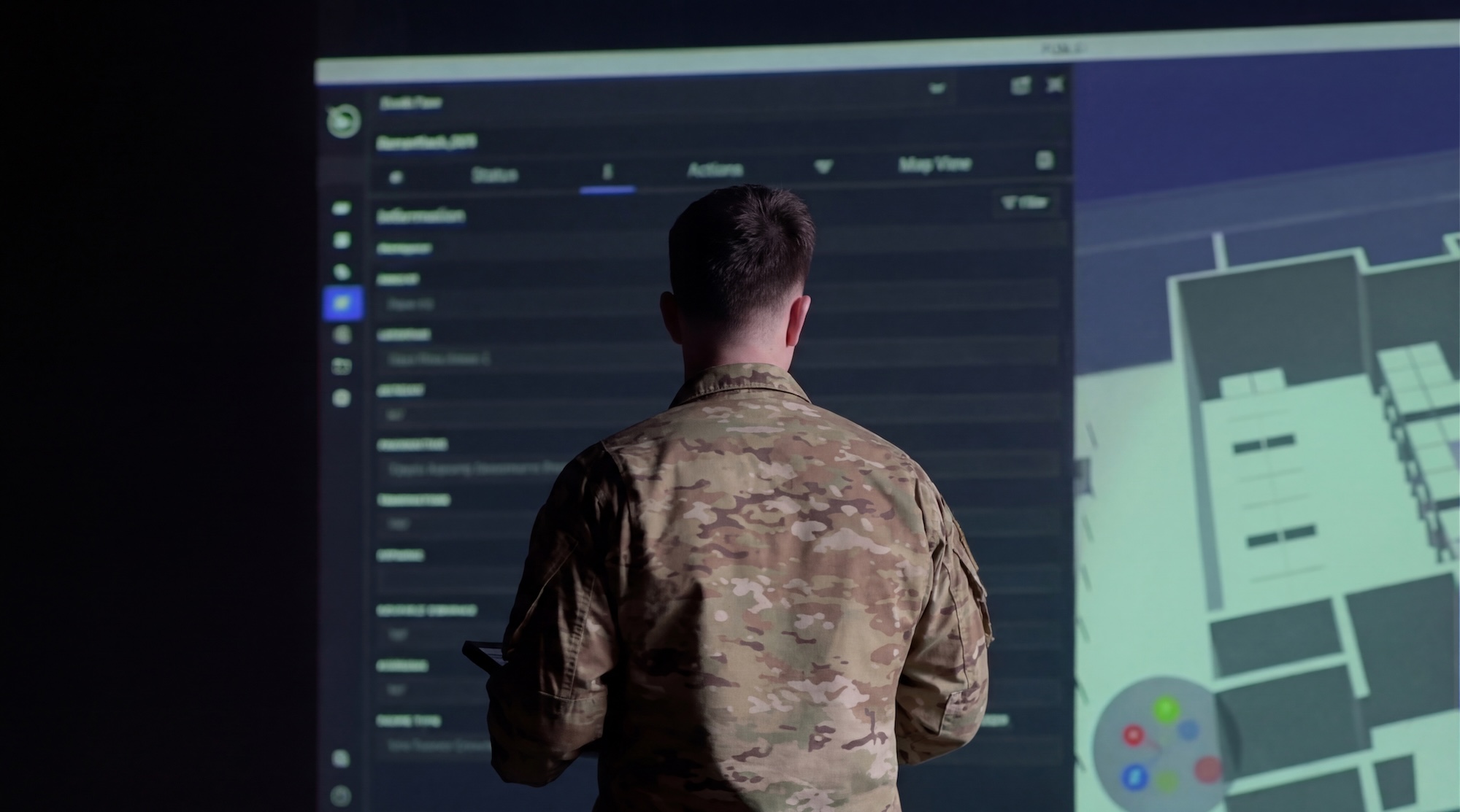
Making AI Operational: How Beast Core Connects Intelligence to Action

Beast Core gives AI something most defense platforms don't: an operational environment with authoritative data, real workflows, and a clean path to action.

Introducing Artificial Intelligence in Beast Core
Most AI in defense never becomes operational. Not because the model is bad, but because there's no environment around it. No workflow. No integration layer. No clean path from model output to mission action.
Beast Core solves that problem.
Our open architecture allows organizations to bring their preferred AI tools into the Beast Core ecosystem as a modular intelligence layer. Rather than forcing customers onto a closed platform, Beast Core provides a flexible environment where artificial intelligence capabilities can be integrated into the data and workflows customers already depend on.
Why Beast Core Is a Strong Foundation for Artificial Intelligence
A Beast Core workspace already contains the ingredients needed to support meaningful AI workflows
Our workspaces aggregate data from disconnected systems into a single environment. 3D models, technical documents, metadata, PLM data, sensor feeds, and operational information all live in one place. Instead of asking users to search across disconnected systems, Beast Core organizes this information into one connected environment.
When you connect AI to that environment, static data becomes real-time intelligence.
For example, a maintainer could ask a question such as, "There are high vibrations on a pump. How should I troubleshoot this?"
With the right AI capability integrated into Beast Core, the platform can identify the relevant technical references, point the user to the correct procedures, and help troubleshoot issues. Rather than returning a generic answer, the response can be backed by authoritative references already connected inside Beast Core.
Building on Proven Predictive Workflows
This is not a brand new direction for Beast Code. We have supported predictive and analytics-driven workflows for years.
In existing deployments, predictive technologies ingest real-time sensor readings and determine when faults are likely to occur. Those resulting fault notifications are brought into Beast Core tagged to the affected component and any supporting details. From there, users can navigate from the notification to visualize the problem in 3D and access the technical information needed to address the issue.
This workflow proves how Beast Core fits into the broader AI ecosystem. Beast Core is where insights become operationally useful. Beast Core is where insights become operationally useful. It connects predictions and analysis back to the asset, the authoritative data, and the user who needs to take action.
We have already supported this approach for multiple customers. AI in Beast Core builds on that same foundation while opening the door to more advanced use cases.
From Information Access to More Natural Workflows
This approach creates a path toward more natural interactions with complex data.
Future iterations can support users who want to interact with Beast Core in more intuitive ways, including natural language requests that would otherwise require deep knowledge of the underlying data structure.
A user might ask Beast Core to render all components related to a Chill Water System, identify whitespace in a schedule, or help surface the information needed to make a decision based on the current state of operations.
In each case, the value does not come from AI in isolation. It comes from connecting AI to a trusted operational environment where models, documents, metadata, and workflows already live together.
A Flexible Artificial Intelligence Layer
As this capability evolves, Beast Code is focused on building an approach that supports flexibility rather than vendor lock.
AI capabilities are changing quickly. Some customers may want to use large language models for question answering and summarization. Others may be more interested in semantic retrieval, predictive analytics, anomaly detection or future orchestration capabilities. Some environments may require cloud-hosted services, while others may need approved capabilities deployed on premises or in disconnected environments.
Beast Core is being extended to support these realities through a modular AI integration layer. This approach helps customers adopt the capabilities that fit their mission, infrastructure, and security requirements without redesigning their operational workflows around a single provider.
Why This Matters
Organizations already have valuable data. The challenge is making that data usable at the speed of operations.
When AI is connected to a Beast Core workspace, users gain a new way to interact with the information they already own. Maintainers can troubleshoot faster. Engineers can locate the right references sooner. Program teams can better understand design, schedule, and operational context. Decision-makers can work from a more connected picture of what is happening and what needs attention.
This is how AI becomes practical. Not as a disconnected chatbot or standalone tool, but as part of an operational environment built around real assets, real workflows, and authoritative information.
Help Shape What Comes Next
We are actively shaping this capability and looking to collaborate with organizations that want to help define how it can be applied in real-world environments.
That includes customers interested in:
- using AI to improve access to technical and operational information
- exploring natural language workflows inside Beast Core
- connecting predictive technologies and other analytic tools into a more usable operational interface
We're looking for stakeholders to participate during the development process and join alpha/beta testing efforts as the capability matures
If your organization is evaluating how to make artificial intelligence more practical, usable, and mission-relevant, Beast Code would love to collaborate with you. Reach out to start the conversation.
Recent Articles